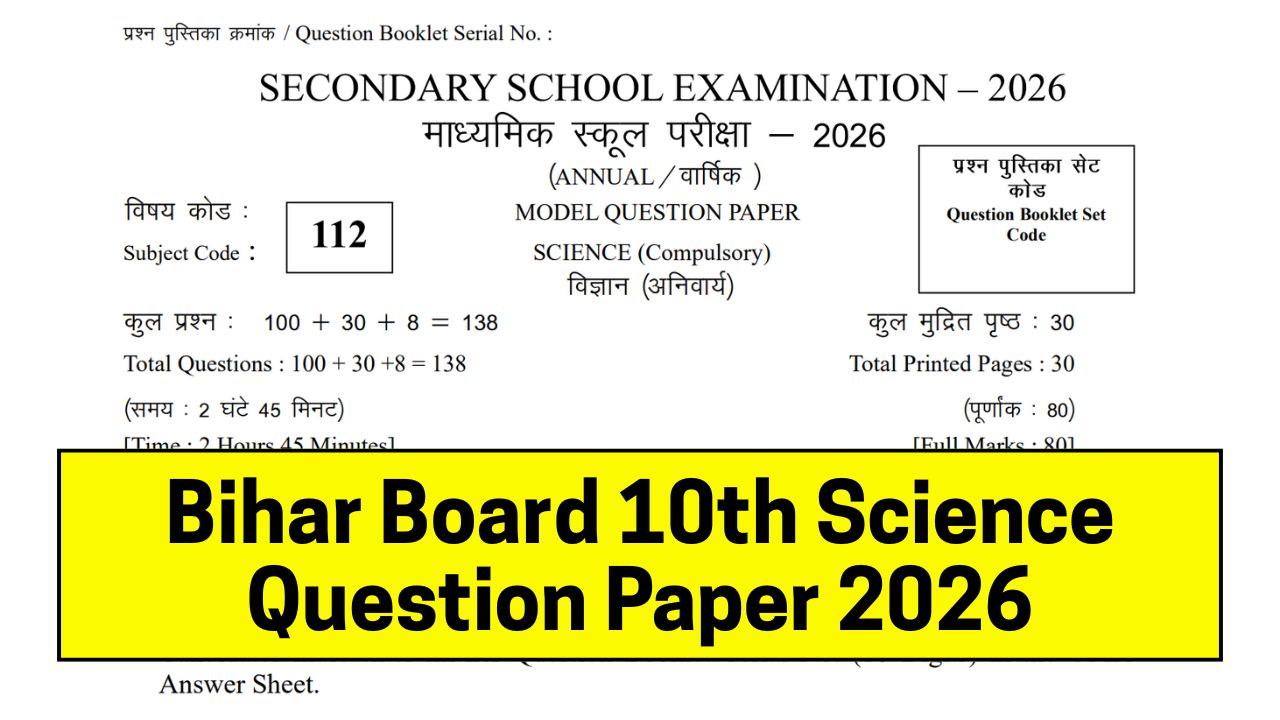


Bihar Board 10th Science Question Paper 2026 के लिए BSEB (Bihar School Examination Board) द्वारा Official Model Question Paper PDF जारी कर दिया गया है।

आप सभी को बता दे कि Bihar Board 10th Science Exam Date 2026 दिनांक 21 फ़रवरी 2026 को होने वाला है।
Bihar Board 10th Science Model Question Paper 2026 बिहार बोर्ड द्वारा जारी किया गया सबसे सही और भरोसेमंद पेपर होता है, जिसमें असली बोर्ड परीक्षा जैसा ही प्रश्न-पैटर्न, कठिनाई स्तर, और किस प्रकार का दिया होता है।

इस मॉडल पेपर की मदद से स्टूडेंट्स को यह समझने में आसानी होती है कि—
- परीक्षा में किस तरह के सवाल आएंगे।
- कितना समय कहाँ देना होगा।
- किस चैप्टर से कितने सवाल आने की संभावना है।
- अपनी तैयारी को कैसे और मजबूत किया जाए।
अगर आप Bihar Board 10th 2026 की Science की तैयारी कर रहे हैं, तो इस मॉडल पेपर से प्रैक्टिस करना बहुत फायदेमंद रहेगा। इससे कॉन्फिडेंस भी बढ़ता है और बोर्ड एग्जाम में अच्छा स्कोर करने में भी मदद मिलती है।
Bihar Board 10th Science Question Paper 2026 – Overview
| Board | BSEB, Patna |
| Class | 10वीं (Matric) |
| Subject | Science |
| Exam Date | Bihar Board 10th Science Exam Date 2026 is on 21st february 2026. |
| Total Marks | 100 (80 Theory + 20 Practical) |
| Paper Formet | MCQ + Short + Long Questions |
| Model Paper | Officially Available |
| Official Website | biharboardonline.com |
Bihar Board 10th Science Question Paper 2026
Bihar Board 10th Science Question Paper 2026 will be released on 21st february 2026 By the Bihar school examination board patna.
Bihar Board 10th Science Question Paper 2026 Paper pattern
Section-A (Objective Type)
- Total Q: 80
- Attempt any: 40
- Marks per Q: 1 mark
- Total: 40 marks
Format: Each question has 4 options, only 1 correct. Marking on OMR sheet.
Section-B (Subjective Type)
Total Question: 24 Short + 6 Long
Part 1 — Short Answer Type Questions
Subjects: Physics + Chemistry + Biology
- Physics: 8 Q
- Chemistry: 8 Q
- Biology: 8 Q
- Attempt: Any 4 from each subject
- Marks: 2 marks/question
- So 4×2×3 = 24 marks
Part 2 — Long Answer Type Questions
- Physics (Q9–10) → Attempt any 1 → 6 marks
- Chemistry (Q19–20) → Attempt any 1 → 5 marks
- Biology (Q29–30) → Attempt any 1 → 5 marks
Bihar Board 10th Science Question Paper 2026
SECTION-A: Objective Questions (Q1 – Q80)
- (1) The focal length of a plane mirror is – (A) Zero (B) Negative (C) Infinity (D) Positive
- (2) Real images are formed on which side of mirror? (A) Behind (B) In front (C) Both (D) None
- (3) If angle of incidence = 30°, angle between rays = ? (A) 30° (B) 15° (C) 120° (D) 60°
- (4) Speed of reflected light = ? if incident speed = C — Options: C/4, C/3, C/2, C
- (5) In spherical mirrors origin lies at? (A) Focus (B) Centre of curvature (C) Pole (D) None
- (6) Light speed denser → rarer medium? (A) Increases (B) Decreases (C) Same (D) None
- (7) During refraction which changes? (A) Frequency (B) Wavelength (C) Colour (D) A & B
- (8) Power of lens having focal length 50 cm? (A) 0.5D (B) 2D (C) 1D (D) 5D
- (9) Oily paper is – (A) Transparent (B) Opaque (C) Translucent (D) None
- (10) Speed of light minimum in – (A) Water (B) Vacuum (C) Glass (D) Air
- (11) Image in eye forms on? (A) Cornea (B) Iris (C) Pupil (D) Retina
- (12) Transparent front part of eye? (A) Iris (B) Cornea (C) Lens (D) Retina
- (13) Which defect corrected by bifocal lens? (A) Myopia (B) Hypermetropia (C) Presbyopia (D) None
- (14) Rod cells sensitive to? (A) Colour (B) Bright light (C) Dim light (D) None
- (15) Blind spot has no– (A) Cornea (B) Rod & Cone (C) Pupil (D) Lens
- (16) Fuse works on which effect? (A) Magnetic (B) Thermal (C) Chemical (D) None
- (17) Which instrument has no (+)(–)? (A) Ammeter (B) Voltmeter (C) Coil (D) Cell
- (18) Watt = ? (A) J/s (B) J/s² (C) J⁻¹s⁻¹ (D) J⁻²s⁻²
- (19) Heater coil made of? (A) Copper (B) Zinc (C) Tungsten (D) Nichrome
- (20) Ability to do work called – (A) Force (B) Power (C) Energy (D) None
- (21) Magnetic effect discovered by – (A) Oersted (B) Ampere (C) Bohr (D) Faraday
- (22) Magnetic field line is – (A) Imaginary (B) Real (C) Both (D) None
- (23) Device producing current – (A) Generator (B) Galvanometer (C) Ammeter (D) Motor
- (24) Short circuit resistance – (A) No change (B) Decreases (C) Increases (D) None
- (25) Nuclear energy element – (A) Helium (B) Aluminium (C) Uranium (D) Chromium
- (26) Main energy source on earth – (A) Coal (B) Sun (C) Water (D) Wood
- (27) Word meaning water – (A) Petro (B) Turbo (C) Nitro (D) Hydro
- (28) Single displacement pair – (A) NaCl+Cu (B) MgCl₂+Cu (C) FeSO₄+Ag (D) AgNO₃+Cu
- (29) Vegetables decomposing → compost is – (A) Endothermic (B) Exothermic (C) Replacement (D) None
- (30) Not oxidation? (A) Combustion (B) Respiration (C) Digestion (D) Precipitation
- (31) Glucose formula – (A) C₂H₅OH (B) C₆H₆O₆ (C) C₆H₁₂O₆ (D) C₆H₆
- (32) Not balanced? (A) 2H₂+O₂→2H₂O (B) 2KClO₃→2KCl+3O₂ (C) H₂+Cl₂→2HCl (D) Pb(NO₃)₂→PbO+NO₂+O₂
- (33) Red litmus → blue: pH? (A)4 (B)11 (C)7 (D)5
- (34) Philosopher’s wool – (A)ZnSO₄ (B)ZnCl₂ (C)ZnO (D)ZnS
- (35) Lime water milky → (A)Cl₂ (B)O₂ (C)NO₂ (D)CO₂
- (36) Bee sting acid – (A)Methanoic (B)Ethanoic (C)Citric (D)Oxalic
- (37) Plaster of Paris – (A) CaSO₄·5H₂O (B) CaSO₄·½H₂O (C) CaSO₄·2H₂O (D) CaSO₄·H₂O
- (38) Acid + base → ? (A) Strong base (B) Strong acid (C) Salt (D) None
- (39) Max valence electrons – (A)Si (B)Al (C)P (D)Na
- (40) Cuprite ore of – (A)Hg (B)Zn (C)Cu (D)Al
- (41) Valency of oxygen – (A)1 (B)0 (C)2 (D)3
- (42) Atomic number of Sulphur – (A)14 (B)15 (C)16 (D)17
- (43) Functional group –CO– is – (A) Aldehyde (B) Ether (C) Alcohol (D) Carbonyl
- (44) Welding gas – (A)Methane (B)Ethyne (C)Ethane (D)Ethene
- (45) Carbon group no. – (A)3 (B)6 (C)13 (D)14
- (46) Covalent bonds in ethyne C≡C – (A)1 (B)2 (C)3 (D)4
- (47) Most reactive halogen – (A)F (B)Cl (C)Br (D)I
- (48) Periods in periodic table – (A)5 (B)6 (C)7 (D)8
- (49) Atomic no. 19 valency – (A)1 (B)2 (C)3 (D)4
- (50) Vertical columns in modern table – (A)7 (B)10 (C)16 (D)18
- (51) Which symbol metal? (A)19/9 A (B)24/12 B (C)12/6 C (D)16/8 D
- (52) Forest-based industry – (A)Paper (B)Timber (C)Lac (D)All
- (53) Irrigation near roots – (A)Rain (B)Mechanical (C)Drip (D)Canal
- (54) Chipko movement year – (A)1971 (B)1973 (C)1981 (D)1988
- (55) Fungi nutrition – (A)Saprotrophic (B)Autotrophic (C)Holozoic (D)None
- (56) Decomposed biologically – (A)Dead leaves (B)Polythene (C)Rubber (D)None
- (57) Human digestion begins – (A)Buccal (B)Pharynx (C)Stomach (D)Small intestine
- (58) Bio-processes – (A)Respiration (B)Nutrition (C)Reproduction (D)All
- (59) Fermentation in – (A)Hydra (B)Amoeba (C)Yeast (D)None
- (60) Gas in aerobic respiration – (A)CO₂ (B)SO₂ (C)N₂ (D)O₂
- (61) Cellular fuel – (A)Fat (B)Protein (C)Glucose (D)None
- (62) Transpiration mostly in – (A)Flower (B)Stem (C)Leaves (D)All
- (63) Heart belongs to – (A)Digestion (B)Respiration (C)Excretion (D)Circulatory
- (64) Blood clotting helper – (A)RBC (B)Fibrinogen (C)Lymph (D)Oxy-Hb
- (65) Waste stored in plants – (A)Bark (B)Vacuoles (C)Leaves (D)All
- (66) Amino acid breakdown → (A)CO₂ (B)SO₂ (C)NH₃ (D)CO
- (67) Kidney function – (A)Digestion (B)Excretion (C)Reproduction (D)ATP
- (68) Plant hormone – (A)Insulin (B)Thyroxine (C)Estrogen (D)Cytokinin
- (69) Fruit ripening hormone – (A)Auxin (B)Gibberellin (C)Ethylene (D)None
- (70) Cranial nerves – (A)12 pairs (B)31 pairs (C)10 pairs (D)24 pairs
- (71) Blood pressure controlled by – (A)Thymus (B)Pancreas (C)Adrenal (D)Testis
- (72) Hydra reproduction – (A)Binary (B)Budding (C)Sexual (D)All
- (73) Male reproductive organ of flower – (A)Stamen (B)Petal (C)Stigma (D)None
- (74) Sperm produced in – (A)Uterus (B)Urinary bladder (C)Ovary (D)Testis
- (75) Before life earth lacked – (A)CO₂ (B)NO₂ (C)O₂ (D)All
- (76) Archaeopteryx true – (A)Fossil (B)Teeth+Nails (C)Wings+Feathers (D)All
- (77) Can change sex – (A)Snails (B)Some reptiles (C)Birds (D)Honey bees
- (78) Comes under environment – (A)Hydrosphere (B)Lithosphere (C)Atmosphere (D)All
- (79) Frog consumer – (A)Primary (B)Secondary (C)Tertiary (D)Quaternary
- (80) Non-biodegradable – (A)DDT (B)Paper (C)Sewage (D)None
SECTION-B (Short Answer + Long Answer)
PHYSICS — Short Answer (Q1–Q8)
(Already extracted from file)
→ Q1 to Q8 list:
- What is magnification?
- Why concave lens called diverging lens?
- What is lateral displacement?
- Define strength of electric current.
- Heating effect depends on which factors?
- What is electromagnetic induction?
- Write Maxwell’s right-hand rule.
- What is good source of energy?
PHYSICS — Long Answer (Q9–Q10)
- Ray diagram + principal focus explanation
- Equivalent resistance of series & parallel
CHEMISTRY — Short Answer (Q11–Q18)
- What is combination reaction?
- What is rancidity?
- Use of sodium carbonate in softening hard water
- Why distilled water non-conductor & rain water conductor?
- What is roasting?
- Structural formula & name of pentane isomers
- Why metals lose electrons & form cations?
- Measures for wildlife conservation
CHEMISTRY — Long Answer (Q19–Q20)
- What are natural indicators? How they test acids/bases?
- Difference between metals and non-metals
BIOLOGY — Short Answer (Q21–Q28)
- What are villi? Function?
- What are stomata & location?
- How unicellular organisms remove waste?
- What is dialysis?
- Role of androecium & gynoecium
- What is neurotransmitter?
- Homologous vs Analogous organs
- What is producer?
BIOLOGY — Long Answer (Q29–Q30)
- What is nutrition? Types of nutrition in organisms.
- Five differences between sexual & asexual reproduction.
Important Link

Shubham Kumar currently works in a government position at the block level in his district, where he actively contributes to the administration and public service delivery. Alongside his official duties, he is also a passionate blogger with a deep interest in sharing reliable and up-to-date information on jobs, education, scholarships, and government schemes. His mission is to empower his readers with accurate knowledge, enabling them to make informed decisions, achieve their goals, and lead meaningful lives.