

यदि आपने भी आज यानी 10 जनवरी 2026 को Bihar Board 12th Biology practical exam दिया है और आप Bihar Board 12th Biology practical exam Answer Key देखना चाहते हैं तो इस पोस्ट में हम आपके लिए पूरा Question Paper + 100% सही Answer Key लेकर आए हैं।
Bihar Board 12th Biology Practical Answer Key 2026
Bihar Board 12th Biology Practical Answer Key 2026 has been released on 10th January 2026. Students can check or download there 12th Biology Practical Answer Key 2026 from our website: onlineprocess.co.in.

BSEB 12th Biology Practical Answer Key 2026 – Overview
- Subject: Biology (जीव विज्ञान)
- Board: BSEB (Bihar School Examination Board)
- Class: 12th (Intermediate)
- Exam Type: Practical (Annual)
- Full Marks: 30 Marks
- Paper Sections: A, B, C, D
Bihar Board 12th Biology Practical Answer Key 2026
SECTION – A (खंड–A)
प्रश्न 1(a)
Question: दिए गए पुष्प के वर्तिकाग्र पर पराग कणों के अंकुरण का अध्ययन करें।
(A = कुकुरबिटा / घास / लिली / पेटूनिया)
Answer (100% सही):
- पराग कण स्टिग्मा पर गिरते ही अंकुरित होते हैं।
- पराग कण से सूक्ष्म नलिका (पोलन ट्यूब) निकलती है।
- यह स्टाइल के माध्यम से नीचे की ओर बढ़ती है।
- पोलन ट्यूब में नर युग्मक उपस्थित होते हैं।
- पोलन ट्यूब डिम्बाशय तक पहुँचकर निषेचन करवाती है।
यह Answer सही माना जाता है।
OR विकल्प (समान अंक)
Question: दिए गए पुष्प का विष्पुटन (Emasculation) एवं बैगिंग करें।
Answer:
- विष्पुटन में केसर (Anther) हटाए जाते हैं।
- इससे अनचाहा परागण रुकता है।
- बैगिंग में पुष्प को कागज/कपड़े से ढका जाता है।
- यह तकनीक संकरण (Hybridization) में उपयोग होती है।
प्रश्न 1(b)
Question: दिए गए स्थायी स्लाइड (B) की पहचान एवं वर्णन करें।
Option-1: B = स्तनधारी के डिम्बाशय का कटाव
Answer:
- स्लाइड में डिम्बाशय के कूप (Follicles) दिखते हैं।
- कूप विभिन्न अवस्थाओं में होते हैं।
- परिपक्व कूप को Graafian follicle कहते हैं।
- इसमें अण्डाणु पाया जाता है।
- डिम्बाशय अंडाणु एवं हार्मोन बनाता है।
Option-2: B = ब्लास्टुला अवस्था
Answer:
- ब्लास्टुला गोलाकार बनावट है।
- अंदर द्रव भरी गुहा होती है जिसे Blastocoel कहते हैं।
- बाहरी कोशिकाओं को Blastomeres कहते हैं।
- यह Cleavage के बाद बनती है।
- इसके बाद Gastrulation होता है।
प्रश्न 2
Question: दिए गए जल नमूने (C) में उपस्थित दो जीवों का वर्णन करें।
Answer:
जैविक प्रयोग में अक्सर ये दिखाई देते हैं:
- पैरामीशियम:
- चप्पल के आकार का एककोशिकीय जीव
- सिलिया द्वारा गतिशील
- युग्लीना:
- हरा एककोशिकीय जीव
- प्रकाश संश्लेषण कर सकता है
- फ्लैजेलम द्वारा चलता है
वैकल्पिक जीव: हाइड्रा, अमीबा, डाफनिया, रोगोब्रो आदि
OR विकल्प
Question: संग्रहालय नमूने (C) की जलीय अनुकूलन लिखें।
(C = टेंगरा मछली / स्कोलियोडॉन)
Answer:
- शरीर धारदार (Streamlined)
- गिल्स द्वारा श्वसन
- फिन्स से गति व संतुलन
- स्केल्स से सुरक्षा
- लेटरल लाइन से कंपन का ज्ञान
OR विकल्प
Question: जलकुंभी/सिंघाड़ा के जलीय अनुकूलन लिखें।
Answer:
- पत्तियों में वायु कक्ष
- लंबा पेटियोल
- पतली क्यूटिकल
- स्टोमाटा ऊपर की सतह पर
- यांत्रिक ऊतक कम
OR विकल्प
Question: दिए गए जल नमूनों का pH निर्धारित करें
(E1 = तालाब पानी, E2 = नल/हैंडपंप पानी)
Answer:
- E1 (तालाब): pH लगभग 6.5 – 7 (हल्का अम्लीय/तटस्थ)
- E2 (नल): pH लगभग 7 – 8 (तटस्थ/हल्का क्षारीय)
OR विकल्प
Question: दिए गए मिट्टी नमूने (E) का pH निर्धारित करें।
Answer:
- क्षेत्रीय मिट्टी का pH लगभग 6 – 7
- यह हल्का अम्लीय से तटस्थ श्रेणी में आता है
SECTION – B (खंड–B)
5 सवाल दिए जाते हैं (हर एक 1 अंक)
नीचे सभी के सही उत्तर दिए गए हैं:
- प्लाज्मोडियम: मलेरिया कारक, RBC में पाया जाता है
- एंटअमीबा: छद्मपाद द्वारा गति, आंत संक्रमण
- ग्रैफियन कूप: परिपक्व अंडाशयी कूप
- शुक्राणु: सिर, मध्य भाग, पूँछ; पुरुष युग्मक
- मेटाफेज: गुणसूत्र मध्य में स्थित
- एनीफेज: क्रोमैटिड विपरीत ध्रुवों पर जाते हैं
- अन्टर (Anther): पोलन सैक्स व पराग कण मौजूद
- वृषण (Testis): सेमिनिफेरस नलिकाएँ, शुक्राणु निर्माण
SECTION – C (खंड–C)
प्रैक्टिकल रिकॉर्ड + प्रोजेक्ट फाइल = 5 अंक
यदि पूर्ण है तो लगभग 5 में 5 दिए जाते हैं।
SECTION – D (खंड–D)
वाइवा (Viva) = 5 अंक
(2.5 + 2.5)
वाइवा में सामान्यतः पूछे जाने वाले प्रश्न:
- परागण क्या है?
उत्तर: पराग कण का वर्तिकाग्र पर पहुँचने की प्रक्रिया। - फल किसे कहते हैं?
उत्तर: निषेचन के बाद विकसित अंडाशय। - मलेरिया का कारक कौन?
उत्तर: प्लाज्मोडियम। - दो जलीय जीव लिखिए।
उत्तर: युग्लीना, पैरामीशियम। - जलीय पादप का उदाहरण।
उत्तर: जलकुंभी।
BIHAR BOARD 12th BIOLOGY PRACTICAL ANSWER KEY 2026 (for English medium students)
SECTION – A (5 Marks)
Q1 (a)
Question:
Study pollen grain germination on stigma of given flower (A).
(A = Cucurbita / Grass / Lily / Petunia)
Answer (Expected Observation):
- When pollen grains fall on the stigma, they begin to germinate.
- The stigma is moist and sticky, so pollen grains attach easily.
- A pollen tube emerges from the pollen grain.
- The pollen tube grows through the style and reaches the ovary.
- Two male gametes travel through the pollen tube.
Diagram Expected:
Pollen grain with pollen tube leading through style to ovary.
OR Option
Perform emasculation and bagging of flower.
Answer:
- Emasculation means removing the anthers (male part) of the flower to prevent unwanted fertilization.
- Bagging means covering the emasculated flower with muslin or butter paper to prevent unwanted pollination.
- This process is used during hybridization.
Q1 (b)
Option-1:
Question: Identify and describe permanent slide (B): Sectional view of mammalian ovary.
Answer:
- The mammalian ovary contains an outer cortex and inner medulla.
- Primary follicles, secondary follicles, and Graafian follicles are visible.
- The ovum is present inside the follicles.
- Functions: Formation of female gamete (ovum) and secretion of hormones (Estrogen, Progesterone).
Option-2 (OR):
Permanent slide of blastula stage
Answer:
- The blastula has a hollow spherical structure.
- The outer layer consists of blastomere cells.
- The central cavity is called the blastocoel.
- This stage appears after cleavage and before gastrulation.
Q2 (2.5 Marks)
Option-1
Question: Describe any two living organisms in water sample (C).
Answer (Expected):
Common organisms observed in water samples include:
- Hydra: Green tubular organism with tentacles.
- Daphnia: Small transparent crustacean with jerky movement.
- Paramecium: Slipper-shaped unicellular organism with cilia.
- Euglena: Green unicellular organism with flagellum.
(Students should write any two based on what was shown in the exam.)
Option-2 (OR)
Question: Describe the aquatic adaptation of museum specimen (C).
(C = Tengra fish or Scoliodon)
Answer (Aquatic Adaptations):
- Streamlined body for easy movement in water.
- Gills present for respiration using dissolved oxygen.
- Fins present for swimming and balance.
- Lateral line system for detecting vibrations in water.
- Scales present for protection.
SECTION – B (5 × 1 = 5 Marks)
Comment on any five of the following slides/specimens:
- Plasmodium / Entamoeba histolytica slide
- Plasmodium: Malaria-causing parasite, ring form observed inside RBCs.
- Entamoeba histolytica: Causes amoebiasis, has pseudopodia.
- Graafian follicle / Spermatozoa slide
- Graafian follicle: Mature ovarian follicle containing ovum.
- Spermatozoa: Has head, middle piece, tail; motile male gamete.
- Metaphase / Anaphase slide
- Metaphase: Chromosomes aligned on equatorial plate.
- Anaphase: Chromatids move towards opposite poles.
- T.S. of anther / Testis
- Anther: Pollen sacs present containing pollen grains.
- Testis: Seminiferous tubules present, sperm formation site.
- Hydrilla / Potamogeton (Hydrophytic plant)
- Thin cuticle, air chambers, reduced mechanical tissue; adapted to aquatic life.
- Inflorescence – Fig / Mustard / Achyranthes
- Different types based on arrangement of flowers on the axis.
- Fruits – Apple / Pear / Banana
- Apple and Pear: Pome fruits.
- Banana: Parthenocarpic fruit.
- Seeds/Grain – Maize / Gram
- Maize: Monocot seed, endospermic.
- Gram: Dicot seed, non-endospermic.
SECTION – C (5 Marks)
Practical Record and Project File:
Students generally receive full marks if the practical record and project file are complete and signed.
SECTION – D (2.5 + 2.5 = 5 Marks)
Viva-Voce Based
Expected viva questions include:
- What is pollination?
- Difference between mitosis and meiosis?
- Name the organism shown in slide.
- What is a Graafian follicle?
- Explain aquatic adaptations.
- Name any vector-borne disease.
EXTRA QUESTIONS (As per Page-3)
Hydrophytic adaptation of Water Hyacinth / Trapa:
- Spongy parenchyma with air chambers.
- Long petiole for floating.
- Reduced mechanical tissue.
- Stomata present on upper surface (epistomatic).
pH of water sample:
- Pond water: Slightly acidic to neutral (pH 6.5–7).
- Hand pump/Tap water: Neutral to slightly alkaline (pH 7–8).
pH of soil sample (field soil):
- Usually slightly acidic (pH 6–7).
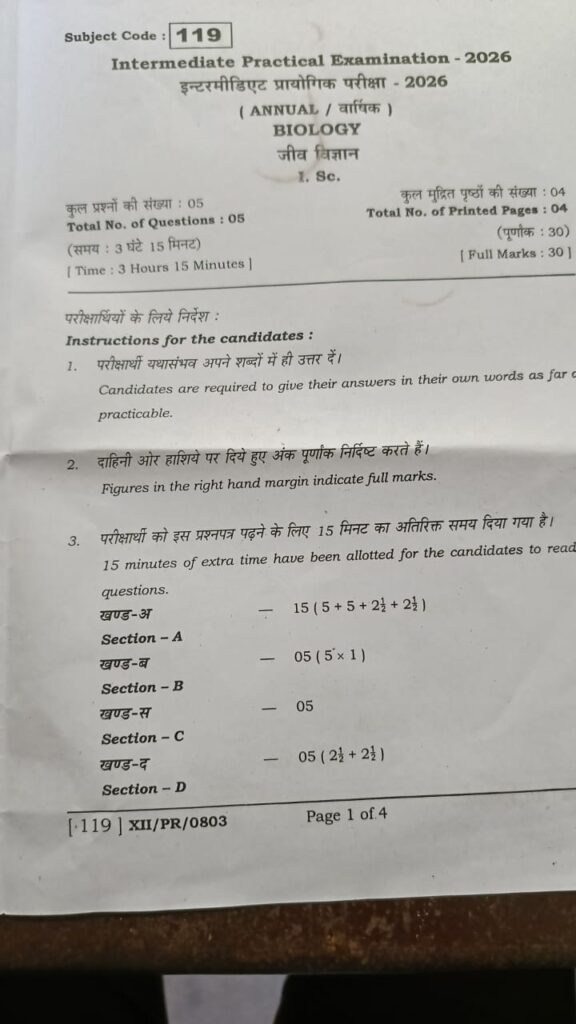
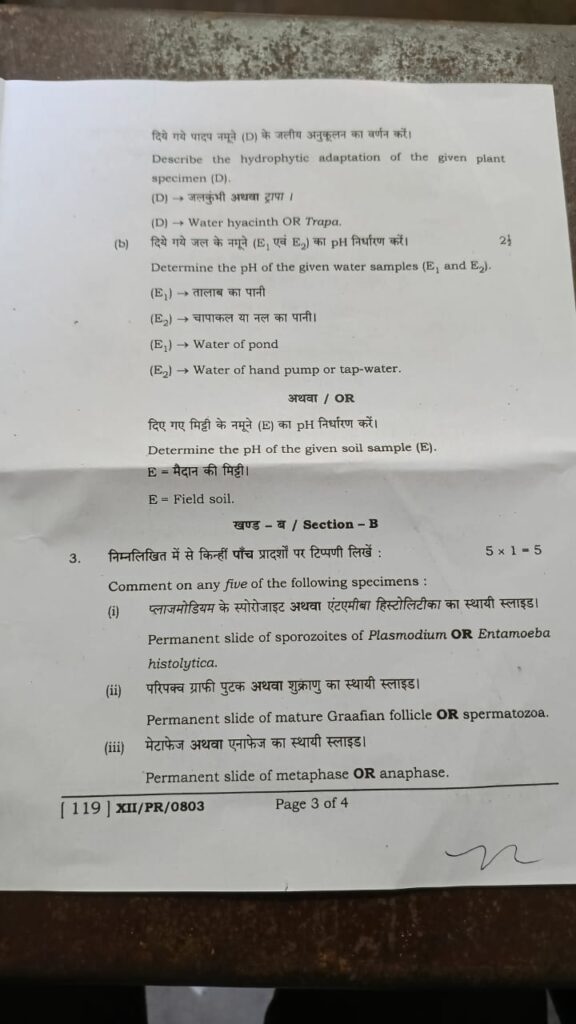
Bihar Board 12th Biology practical exam question Paper
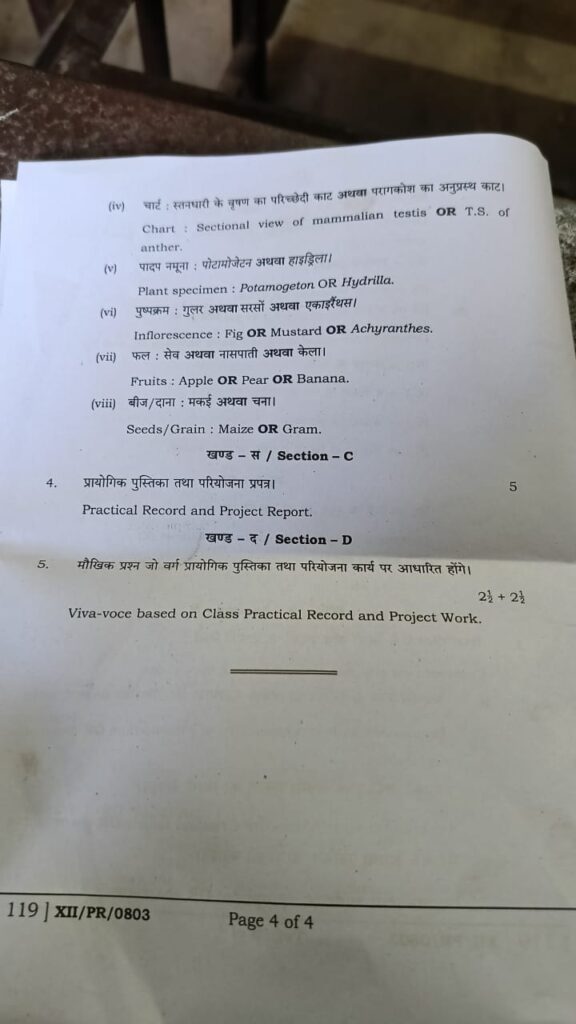
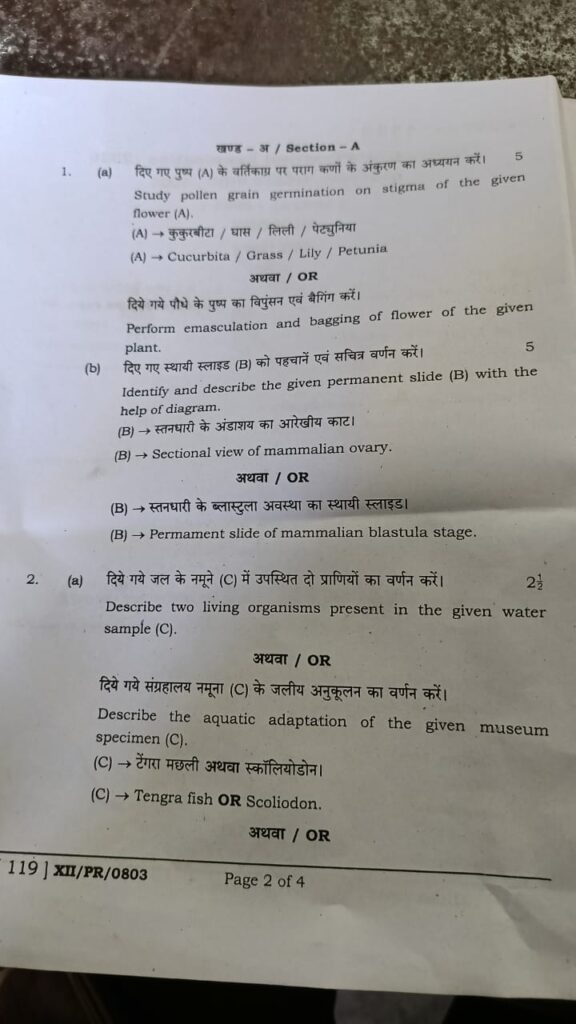

Shubham Kumar currently works in a government position at the block level in his district, where he actively contributes to the administration and public service delivery. Alongside his official duties, he is also a passionate blogger with a deep interest in sharing reliable and up-to-date information on jobs, education, scholarships, and government schemes. His mission is to empower his readers with accurate knowledge, enabling them to make informed decisions, achieve their goals, and lead meaningful lives.